- Mining & Energy
- Posts
- The M&E DISPATCH // 138
The M&E DISPATCH // 138
These are 72 hours for the history books...
THE DISPATCH

Featured CompanyPre-Bid Spy is a procurement intelligence platform that monitors municipal council meetings across Canada to identify funded opportunities before they become public tenders. By providing early access to project details and decision-maker contact information, Pre-Bid Spy helps businesses build relationships and win contracts before the competition even knows they exist. | 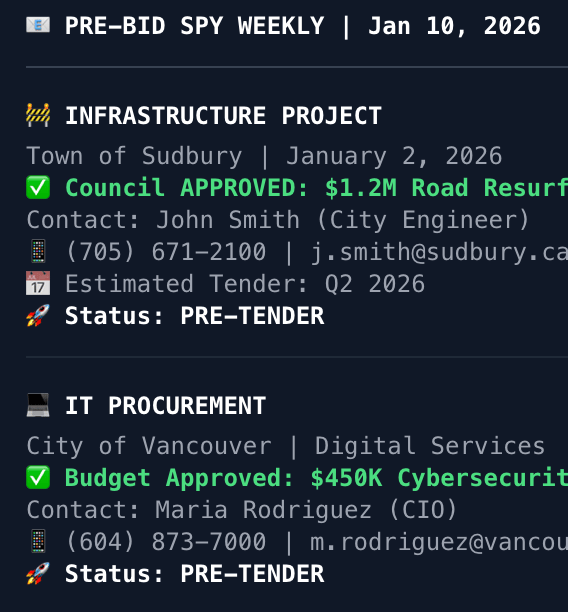 |

What the Pattern Reveals About Canada’s Future.
Venezuela, Greenland, and the Alberta Wildcard…
If we look at these things not as singular events, but as parts of a whole, what does the future hold for Canada?
The Pattern Emerges
Three days ago, the United States military captured Venezuelan President Nicolás Maduro.
Three days ago, President Trump refused to rule out military action against Greenland.
Three days ago, Elections Alberta approved the Alberta Prosperity Project’s petition for an independence referendum.
These aren’t isolated incidents. They’re data points in an emerging doctrine that’s rewriting the rules of continental resource politics, all unfolding within the same 72-hour window.
In his press conference following the Venezuela operation, Trump was explicit about motivation: “We’re going to have our very large United States oil companies...spend billions of dollars, fix the badly broken infrastructure, the oil infrastructure, and start making money for the country”. This wasn’t regime change dressed up as democracy promotion. This was resource acquisition with military backing.
The U.S. National Security Strategy, released in December, formalizes this approach through what it explicitly calls the “Trump Corollary” to the Monroe Doctrine. The language matters: “assert and enforce” U.S. pre-eminence in the Western Hemisphere and deny non-hemispheric competitors the ability to position forces or assets. It applies to the entire hemisphere. Not just Latin America. Not just the Caribbean. The entire Western Hemisphere.
When Trump says of Greenland, a NATO member through Denmark, that “We do need Greenland, absolutely,” and refuses to rule out military force, he’s not negotiating. He’s signaling. When Greenland’s government explicitly rejects the overture, and Denmark’s Prime Minister warns that an attack on Greenland would mean “the end of NATO,” the Trump administration doesn’t walk it back. It doubles down.
Here’s what most Canadian analysts are missing: Venezuela provides the precedent. Greenland tests the framework. Alberta could be the trigger, all in the same week.
The Alberta Vector
The Alberta Prosperity Project isn’t a fringe movement. On January 3, 2026, the same day U.S. forces captured Maduro, Elections Alberta gave formal approval to collect signatures for an independence referendum. They have 120 days to collect 177,732 signatures, representing 10% of the 2023 provincial election voters.
Current Alberta polling shows 25-30% baseline support for separation, with that number rising to 45%+ when survey respondents are asked about resource control or federal overreach on energy policy. A referendum with 35-40% support for separation would normally be dismissed as a regional political moment. In the Trump doctrine framework, it becomes a justification.
The scenario Homer-Dixon and Gordon outlined in The Globe and Mail isn’t speculation. It’s a plausible sequence:
A referendum where Alberta votes to stay Canadian by 70-30, but with substantial separatist support. Trump declares the result “fake.” Alberta separatists appeal to Washington for support, citing resource control disputes with the federal government. U.S. forces mass at the Montana border. The demand: Alberta must be allowed to join the United States as the 51st state, with guaranteed control over its oil reserves.
What international legal framework stops this? The same one that should have stopped Venezuela. Respect for state sovereignty. Prohibition on use of force. Non-intervention. Those rules failed in Venezuela. Why would they hold for Canada?
What Changes in the Resource Calculus
Canada has 168 billion barrels of proven oil reserves, the world’s third-largest proven reserves, concentrated in Alberta. We have critical mineral deposits worth trillions. We control 20% of the world’s freshwater. From the perspective of a resource-maximizing U.S. administration, this isn’t a sovereign nation. It’s a resource hinterland awaiting management.
The Trump administration has already positioned itself in Canadian critical minerals. The administration acquired equity stakes in Lithium Americas and Trilogy Metals, establishing both financial interest and intelligence infrastructure in Canadian resource sectors. When the administration’s Critical Minerals Production Alliance states it aims to “operationalize projects that will strengthen global critical minerals supply chains” under U.S. control, what they mean is: these assets need to be under U.S. control.
For mining and energy executives, this changes everything about long-term capital allocation. You’re no longer evaluating regulatory risk or tax policy. You’re evaluating the risk of expropriation under military threat. You’re reassessing whether Canadian sovereignty over resource assets remains a defensible assumption.
The Diplomatic Isolation Problem
Here’s the harder truth; Canada may not have allies willing to stand with us if this escalates.
The Trump administration has made clear its contempt for multilateral frameworks. It’s replacing NAFTA terms with bilateral deals. It’s signalling that countries supporting Canada against U.S. resource interests will face consequences. European allies, dependent on U.S. security guarantees for their own defence against Russia, aren’t going to risk their security posture to defend Canadian sovereignty.
NATO Article 5 was designed for external threats, not intra-alliance coercion. If U.S. forces mass at the Alberta border, will NATO activate? The answer is almost certainly no. NATO members will debate the legality, express concern, issue statements. And then they’ll accept a new geopolitical reality where the Western Hemisphere belongs to Washington.
Mexico faces a similar vulnerability. Finland and the Baltic states are now watching to see how the Trump administration treats a continental neighbour. Taiwan is paying close attention. If the U.S. military can redraw the map in its own hemisphere without consequence, what does that signal about security commitments elsewhere?
What This Means for Tomorrow
The Venezuela operation isn’t primarily about Venezuela. It’s a demonstration project. It’s showing allies and adversaries alike that the United States will use military force to secure resource access, that international law won’t constrain it, and that continental neighbours can’t rely on existing agreements or institutions for protection.
// THE DIRT
 FEATURED RELEASEDo you have a release you want to make sure is covered? Here’s the spot for it. Hit reply and I’ll fill you in. | FEATURED STORYHave a story or update you want covered? Here’s the spot for it. Hit reply and I’ll fill you in. |
A Closing Thought
NOTES FROM THE NORTH
“Times, they are a changing. “
The week my son and his teammates fly across the country to a CSSHL showcase in Delta BC and last night at dinner the discussion should have been around that…
it wasn’t.
For these kids the world changed significantly over the weekend, more so for them than for us, and well, they know. They're already asking questions that are incredibly uncomfortable.
Our billet, from a former Soviet State, is staring down mandatory Military Service in just a couple years. With a hostile neighbour on a quest to restore The Union to that of it's former glory, by force, his fears are just.
It's easy for us older adults to say things like "Don't worry, you wont have to go to war" or "Of course you'll always be able to go to school in the States" as that was true for our generation.
Those are not statements that I’m comfortable making anymore.
Maybe the end of the Hudson Bay Company last summer was more symbolic than it first appeared.
Some days grow bigger than their hours, stretch beyond their week and are remembered for more than a lifetime. This was one of them.
-Lee
All the great things are simple, and many can be expressed in a single word: freedom, justice, honour, duty, mercy, hope. - Churchill